
Your soil tells a story. Let's read it together.
I'm here to help with any gardening need. A plant that isn't going to make it, compost you're scared to use, a school garden that won't grow, yellow leaves, a mystery bug or a pile that stinks: I'm here. I test, I look under the microscope, and I leave you a plan kids can follow.
I always put the kids and the soil first, so I'll work with any budget.
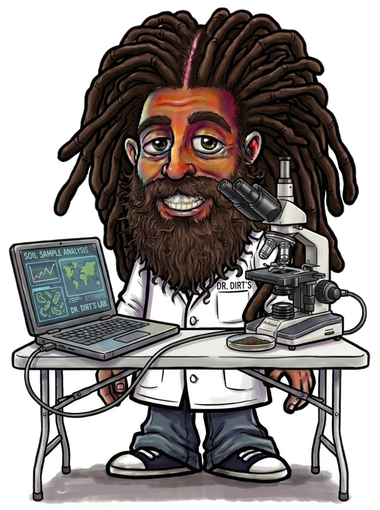
How I help schools
Every visit is planned around your problem, your garden and your kids. Kids and soil come first, so whatever your budget is, we'll make it work. Call or send a note, and I'll send a clear price before anything is scheduled.
School garden diagnosis
I come to your garden with my field lab: samples from each bed, live microscopy, pH, redox, salts and N-P-K, and a written plan with what to add (and what to stop adding).
Ask for a visitMicroscope lesson
Real soil from your garden on a big screen. Kids find bacteria, fungi, protozoa and nematodes, and learn who helps plants and who hurts them.
Book a lessonThe best Dr. Seuss reading ever
23 years of reading Dr. Seuss in classrooms. Stories that start conversations about right and wrong, and a garden book or two of my own.
Invite Dr. DirtCompost and worm bin check-up
Is your pile hot enough? Is the worm bin happy? I test it, look at its life under the microscope, and show the class how to fix it.
Ask about itGrow With Dr. Dirt 2.0 in class
Every child gets a half-acre garden in the game, grown by your school's real weather, with lessons and teacher controls.
See the Classroom ExperienceCrop and cover crop plan
What to plant, when and where, matched to your place, your elevation and your goals, with cover crops that feed the soil between seasons.
Ask for a planSoil testing
Pay now, then bring your sample and your voucher code to my table at the Makuʻu Farmers Market (Sundays, 7:30 a.m.–2 p.m.), or call to set up a drop-off. You leave with a plan, not a guess.
Soil check (Core Test)
pH, salts (EC), redox, a quick look under the microscope and a prescription. Brix too, with fresh young leaves.
Three-layer soil profile
The top, middle and deep soil tested separately, then one plan for the whole root zone. My favorite.
NPK test (soil or plant)
Nitrogen, phosphorus and potassium in the soil, or in the plant itself.
NPK test (soil and plant)
Both, side by side: is the food in the soil, and is the plant getting it?
MicroBIOMETER add-on
How much life is in your soil, and the balance of fungi to bacteria.
Your order
Tap + on a test to add it.
Hawaiʻi general excise tax (4%) is added. Payments are processed securely by Square.
How to take a soil sample
- Brush away the mulch and leaves so you see bare soil.
- Dig straight down about six inches (the length of a pencil).
- Take a little soil from the top, the middle and the bottom. Keep each in its own clean bag or tube.
- Never squish or pack it: soil life needs its air.
- Put the bags in a paper bag to keep them dark and cool, and bring them the same morning.
- For a leaf test, bring fresh young leaves picked before noon.
Why so careful?
Heat, light, waiting and squishing all change what lives in the soil. A careful sample tells the true story, and a true story means a better plan.
Pocket Lab
Pocket Lab puts a soil lab in a kid's hands. Mix the soil test, hold up the phone, and the camera reads the colors: nitrogen, phosphorus and potassium. Then it explains what the numbers mean and what the plant needs.
- Connects kids to the garden: they test a real plant, then follow that same plant in Grow With Dr. Dirt.
- Easy for beginners: no science background needed. Every reading comes with a plain-words plan.
- Real data collection: every test is saved, so kids see their garden change over weeks and seasons.
- Good farm practices: test first, then feed only what is needed. Measured, never guessed.
Science, made friendly
Kids learn to predict, test, record and compare: the same steps real scientists use, with their own garden as the lab.
Healthy soil, clean water
When gardens and farms get more fertilizer than plants can use, the extra washes away with the rain. Here on our porous volcanic island it sinks fast, reaches streams and the ocean, and feeds algal blooms: thick green carpets of algae that use up the oxygen fish and coral need. It also feeds invasive weeds.
That's why everything I do is sustainable and regenerative. I measure before anything is added, feed the soil life instead of just the plant, and use natural amendments in the amounts a plant can really use. Living soil holds onto its food, so less of it ever reaches the watershed.
Kids can help the ocean
- Test before you feed.
- Keep soil covered with mulch or cover crops.
- Compost your scraps: it's food that stays put.
- Never feed a plant “just in case.”
The original Grow With Dr. Dirt
Before 2.0 there was the first game: built from a customer's farm map and my children's imagination.